
The world around us provides unlimited inspiration and opportunities for us to respond creatively. But how we look determines what we can imagine.
Left Brain vs. Right Brain
In her classic books on drawing and creativity, Betty Edwards talks about how the two sides of the brain process information differently. The left (verbal) side of the brain is chatty, abstract, and likes to take charge. The right (visual) side of the brain is concrete, takes in all the glorious details, and prefers to communicate through what we call intuition—which I think of as information we’ve taken in but aren’t yet consciously (or verbally) aware of.
Neither side of the brain is right or better than the other. We need both. They are connected through the corpus callosum, which is a membrane that allows electrical signals to travel between the sides of the brain. The signals we take in visually are shared with the verbal side of our brain, allowing us to talk about what we see. Conversely, the words we use and comprehend determine what we can see and draw our attention to.
Perception and Conception
The design process harnesses both of these thinking styles to invent new possibilities that are still grounded in context and reality.
Early in a design project, I’ll take a look at everything I can. This often looks messy and makes clients a little nervous. I’ll talk with employees who complete a critical process. I say things like, “Show me what you do next. What’s on your screen?” I’ll examine how similar organizations might approach a challenge.
In short, I am doing my best to perceive both the details and the fuller context. I do my best to turn off any judgments in my brain about what I think is happening, or how things should be.
Those judgments are concepts and belong to the left side of the brain. Concepts are incredibly important, because they allow us to identify familiar events or ideas, without having to analyze them each and every time we encounter them.
For example, “Employee Onboarding” is a concept. We can refer to it, and most people should understand when it happens, for whom, and roughly what is included.
Later stages of the design process deliberately allow us to play with concepts and mashing up new ideas. At this point, we turn away from the existing details and focus more what we could make instead.
Donut Hole or Whole Donut?
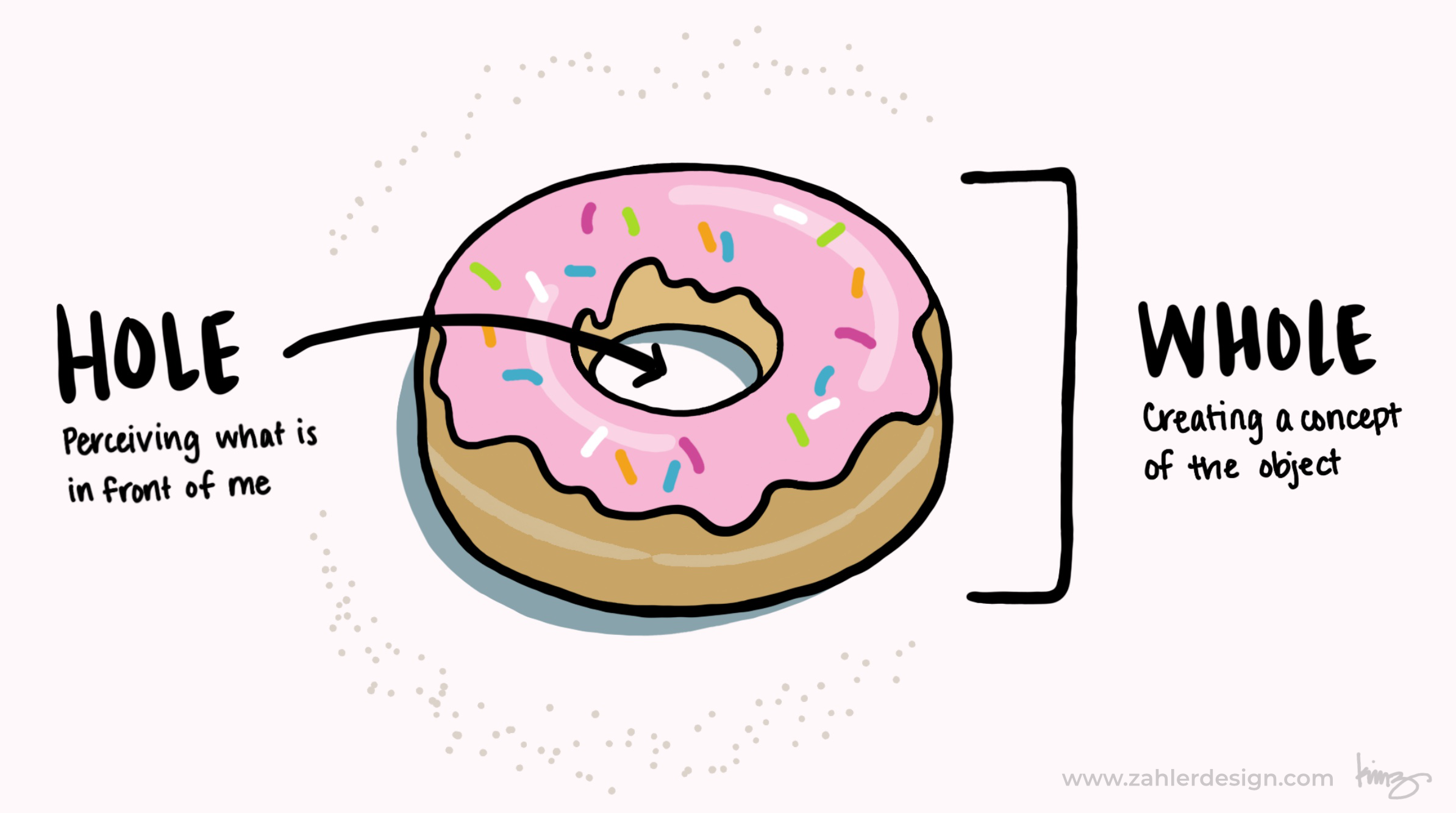
The problem is when concepts blind us to what is actually happening. That’s when we need to go back to perceiving. I may think that my Employee Onboarding is sufficient, but new employees might tell me otherwise when they can’t log on to their computers.
I hope this post inspires some new thoughts and ways of looking at the world. Or maybe just makes you hungry for donuts. Sorry about that.